newsletter | Publish | pembaharuan: Tuesday, 23 May 2023 | viewed: 451 times
Promoting Behavioural Change in Rural Cambodia
How has the TRWSS-SDP (Third Rural Water Supply and Sanitation-Sector Development Project) managed the change?
Behavioural change is about altering habits and behaviours for the long term. According to some experts: Behavioural change theories are attempts to explain why human behaviours change. These theories cite environmental, personal, and behavioural characteristics as the major factors in behavioural determination. In recent years, there has been increased interest in the application of these theories in the areas of health, education, criminology, energy and international development with the hope that understanding behavioural change will improve the services offered in these areas. The various Impacts of Behavioural Changes that one can look forward with healthy and sustainable behavioural changes are: Encourages a positive attitude. Better health outcomes & overall well-being. Anchor all dimensions of physical, emotional, social and spiritual wellness.
PT INACON Luhur Pertiwi has been providing consulting services to the Third Rural Water Supply and Sanitation-Sector Development Project (TRWSS-SDP) since 2020. TRWSS-SDP seeks to contribute to the achievement of universal access to safe water supply and sanitation services in Cambodia by 2025. The outcome of the project is universal access to safe and uninterrupted rural water supply and sanitation services in participating 17 districts in 10 provinces, to be pursued through the following three outputs: ? Output 1: Rural water supply infrastructure and services improved and expanded. ? Output 2: Rural sanitation infrastructure and services improved and expanded. ? Output 3: Institutional capacity improved. The project has been implemented in four batches of subprojects; Batch 1 includes 153 villages in 15 subprojects or 15 communes, Batch 2 covers 168 villages in 18 communes, Batch 3 covers 130 villages in 16 communes, and Batch 4 covers 49 villages in 7 communes. After the completion of 4 batches, 500 villages in 56 communes will have been covered, exceeding the project target of 400 villages and 40 communes.
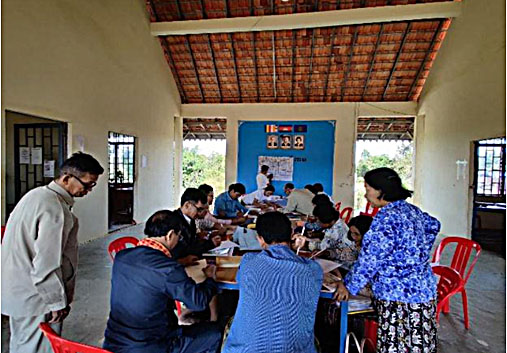
The purpose of this article is to provide and to share information on the behavioural change promotion activities among the beneficiary communities in the project. Behavioural Change. The project has been promoting the 3 key behaviours of always drinking safe water, washing hands with soap, and using latrines for defecation to ensure the communities gain better health outcomes & overall well-being from the access to improved water and sanitation infrastructure. The behaviour change promotion is conducted through the behaviour change communication (BCC) activities conducted by the village and commune focal persons with support from the provincial department of rural development in each of the 10 provinces.
Sanitation and hygiene behaviour change communication (SHBC) tools including posters, pictures, key messages were displayed and distributed, and the focal persons engaged the communities through discussions and dialogues. The Community Led Total Sanitation (CLTS) steps to trigger the communities’ commitment to stopping open defecation are conducted by trained facilitators. To promote the behaviour of always drinking safe water, communication materials on simple water treatment and safe storage of drinking water have been used. BCC as well as CLTS approach have been widely adopted in rural Cambodia since 2005.
Students from schools that have been provided with water and/or sanitation facilities are engaged in school water supply, sanitation, and hygiene promotion activities facilitated by provincial project teams, village, and commune focal persons, with participation of the school principals, teachers, and members of the school support committees. The school children are also encouraged to share the key messages with their family members and neighbours.
Community members visiting health centres that have been provided with water supply and/or sanitation facilities are exposed to messages and pictures of the three behaviours. Key messages to improve sanitation and hygiene and the prevention measures of Covid-19 in their communities were shared by Commune Councils and Village chiefs who are members of the Health Centre Management Committee (HCMC). Various events that bring together many community members have been utilized to disseminate and reinforce the messages. These include the community consultation meetings, national sanitation day, handwashing day as well as traditional events of Pchum Benh and religious gatherings at the local pagodas.
During monitoring visits, the national and provincial project teams also take the opportunity to motivate the communities to adopt the three behaviours. As of end of March 2023, approximately 40,000 households (HHs) have been reached with BCC activities. The project has supported a total of 2,823 communal water supply facilities consisting of: 2586 new drilled wells, 121 rehabilitated drilled wells, 70 rehabilitated dug wells, 40 rehabilitated community ponds and 6 small-piped water systems. This represents 113 % of the project ‘s target of 2,500 communal water supply facilities constructed and/or rehabilitated. In addition to these, a total of 117,444 rainwater jars have been provided in areas where communal facilities are not feasible.
Data shows that improved access to these facilities enables the communities to adopt the behaviour of drinking safe water. Of course, the ultimate results are the adoption of the three behaviours which has yet to be measured in a systematic way. The project will organize an impact survey towards the end of the project period which is scheduled for June 2024. In the mean time, an initiative to measure the results of behaviour change promotion under Batch 1 indicates that the practice of open defecation has decreased from 45% to 8% and the practice of handwashing with soap has increased from 72% to 98%. It is also important to note that changes in behaviour have been happening under the sanitation program indicated by the attainment of open defecation free (ODF) status of 26 communes as of end of March 2023.
Behaviour change promotion, often referred to as the “software” aspect of the rural water supply, sanitation, and hygiene improvement projects, is always challenging as changing behaviour requires more than provision of “hardware” or facilities. In carrying out the behaviour change promotion; the project has benefited from the established national guide as well as the experiences within the sector. The availability of trained and dedicated personnel to spearhead BCC activities has enabled rapport with the communities. These personnel, from provincial to village level, have in-depth understanding of the culture and tradition of the target communities.
The village and commune focal persons enable frequent interaction with the communities which is an important contributing factor. The project is continuing the efforts to reach the target of at least 40 ODF communes by mid 2024 and evidence-based results of behaviour change promotion.